What Time Was It 16 Hours Ago From Now? (Quick Calculator + Full Guide)
You glanced at a message timestamp, tried to convert a server log, or you’re just trying to figure out what time it was on the other side of a long shift — and now you need to know exactly what time it was 16 hours ago. It sounds simple until you actually try to do the math in your head and realize you’ve crossed midnight, lost track of AM/PM, or forgotten which day you landed on.
This guide walks you through the exact method for calculating any time in the past, gives you ready-made tables so you don’t have to do mental math, and clears up the mistakes almost everyone makes with backward time calculations.
Quick Answer
To find what time it was 16 hours ago from now, subtract 16 hours from your current time. Since a day only has 24 hours, subtracting 16 hours means you’ll almost always land on the previous day, unless your current time is after 4:00 PM (16:00), in which case you’ll stay on the same calendar day.
The formula is simple:
Current Time − 16 hours = Time 16 hours ago
If your current time is earlier than 16:00 (4:00 PM), you subtract 16 and roll back to yesterday’s date. If it’s later than 16:00, you subtract 16 and stay on today’s date.
Why This Calculation Trips People Up
Subtracting hours seems like basic arithmetic, but 16 hours is an awkward number. It’s more than half a day but less than a full day, so it almost guarantees a date change unless you’re checking in the late afternoon or evening. Add a 12-hour clock with AM/PM into the mix, and it’s easy to subtract correctly but still get the wrong label.
Here’s the thing: your brain is used to subtracting small numbers like 2 or 3 hours. Sixteen hours forces a full mental reset — you have to think in 24-hour terms, track the date, and then convert back to 12-hour format if that’s what you use daily.
Step-by-Step: How to Calculate 16 Hours Ago
Follow this process and you’ll never get it wrong.
Step 1: Convert your current time to 24-hour format
If you’re using AM/PM, convert it first. This removes the guesswork.
- 9:00 AM → 09:00
- 2:30 PM → 14:30
- 11:45 PM → 23:45
Step 2: Subtract 16 hours
Just subtract straight from the 24-hour number.
- 09:00 − 16:00 = -07:00
Step 3: If the result is negative, add 24 hours and move back one day
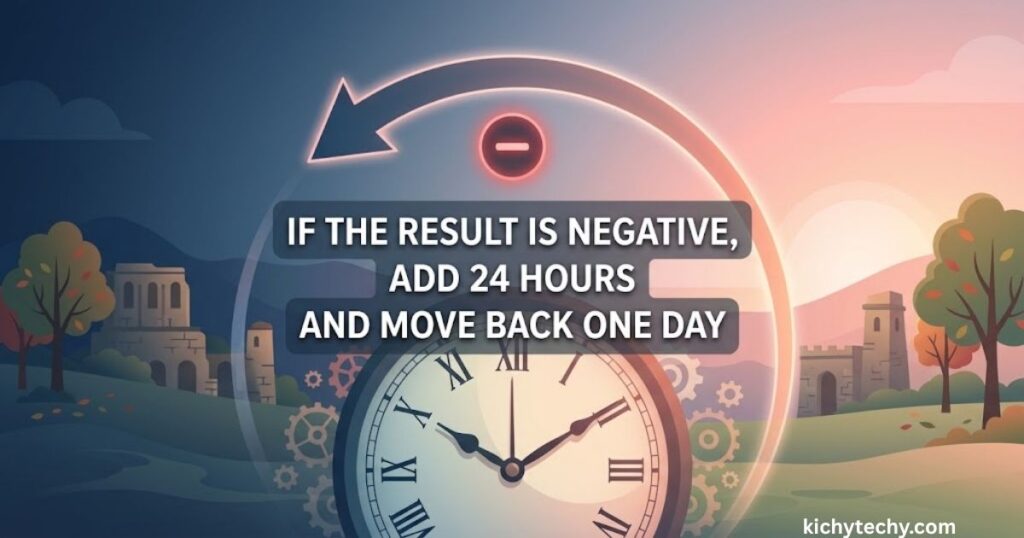
- -07:00 + 24:00 = 17:00 (yesterday)
Step 4: Convert back to 12-hour format if needed
- 17:00 → 5:00 PM (yesterday)
That’s it. Four steps, and you’ll never second-guess yourself again.
Worked Examples Table
Here’s how the math plays out across different starting times. Use this as a reference chart.
| Current Time (Today) | 16 Hours Ago | Same Day or Previous Day? |
| 6:00 AM | 2:00 PM | Previous day |
| 8:00 AM | 4:00 PM | Previous day |
| 10:30 AM | 6:30 PM | Previous day |
| 12:00 PM (Noon) | 8:00 PM | Previous day |
| 2:00 PM | 10:00 PM | Previous day |
| 4:00 PM | 12:00 AM (Midnight) | Previous day (boundary case) |
| 6:00 PM | 2:00 AM | Same day |
| 8:00 PM | 4:00 AM | Same day |
| 10:00 PM | 6:00 AM | Same day |
| 11:59 PM | 7:59 AM | Same day |
Notice the pattern: anything before 4:00 PM lands you on yesterday. Anything at or after 4:00 PM lands you on today, just much earlier.
The 4:00 PM Rule

This is the single most useful shortcut in this entire article, so remember it:
If your current time is before 4:00 PM, the answer will be on yesterday’s date. If your current time is at or after 4:00 PM, the answer will be on today’s date.
Why 4:00 PM? Because 24 hours minus 16 hours equals 8 hours. So any time from midnight up to 4:00 PM, when you go back 16 hours, pushes you past midnight into the previous day. Once you hit 4:00 PM or later, subtracting 16 hours keeps you within the same 24-hour window.
Common Mistakes People Make
Even though the math is straightforward, plenty of people get tripped up. Here’s what usually goes wrong.
Forgetting the date change entirely. Someone calculates “16 hours before 9:00 AM” and just says “5:00 PM” without realizing it’s 5:00 PM the day before, not later today. This is the single most common error.
Mixing up AM and PM after the subtraction. When you convert 24-hour time back to 12-hour format, it’s easy to flip AM and PM by accident, especially around the noon and midnight boundaries.
Confusing “16 hours ago” with “16 hours from now.” These are opposite directions. One goes backward in time, the other goes forward. If you’re troubleshooting a timestamp or trying to verify an alibi, direction matters a lot.
Not accounting for time zone differences. If you’re calculating “16 hours ago” for someone in a different time zone, you can’t just subtract from your local clock. You need to convert to their zone first, then subtract.
Ignoring daylight saving time shifts. If the 16-hour window happens to cross a DST changeover (rare, but it happens twice a year in regions that observe it), the actual gap might be 15 or 17 hours instead of exactly 16.
Real-World Scenarios Where This Matters
This isn’t just a trivia question. People search for this calculation for genuinely practical reasons.
Shift workers and night shifts. If you clocked out at 6:00 AM after an overnight shift, knowing what time it was 16 hours ago (2:00 PM the previous day) helps you track exactly when your shift started relative to a specific event.
Remote teams across time zones. If a colleague in another country sent a message and you’re trying to figure out what their local time was 16 hours before their message, this calculation bridges that gap quickly.
Flight and travel planning. Long-haul flights often last close to 16 hours. Passengers want to know what time it was back home when they took off, especially for coordinating calls or check-ins.
Digital forensics and log analysis. IT professionals and security analysts frequently need to trace backward from a server timestamp to figure out when an event actually originated, especially when logs are recorded in UTC.
Medical and dosage tracking. Some medications are taken on 16-hour intervals. Patients or caregivers need a fast way to check when the last dose should have been given.
Time Zone Adjusted Table (UTC Reference)
If you’re working across time zones, here’s a quick reference showing how 16 hours ago plays out relative to UTC for a few common zones. Assume the current UTC time is 12:00 PM (noon).
| Time Zone | Current Local Time | Time 16 Hours Ago (Local) |
| UTC | 12:00 PM | 8:00 PM (previous day) |
| EST (UTC-5) | 7:00 AM | 3:00 PM (previous day) |
| PST (UTC-8) | 4:00 AM | 12:00 PM (previous day) |
| GMT (UTC+0) | 12:00 PM | 8:00 PM (previous day) |
| CET (UTC+1) | 1:00 PM | 9:00 PM (previous day) |
| IST (UTC+5:30) | 5:30 PM | 1:30 AM (same day) |
| JST (UTC+9) | 9:00 PM | 5:00 AM (same day) |
| AEST (UTC+10) | 10:00 PM | 6:00 AM (same day) |
This table shows why the “4:00 PM rule” only works for your own local clock. Once you cross zones, you need to apply the subtraction to each zone’s own local time separately.
Related Time Calculations You Might Also Need
Once you’ve got 16 hours down, these related calculations use the exact same method:
- What time was it 12 hours ago — usually the easiest, since it just flips AM/PM on the same numeric hour.
- What time was it 24 hours ago — always the same time, just the previous day.
- What time will it be 16 hours from now — same method, but you add instead of subtract.
- What time was it 20 hours ago — follow the same 24-hour subtraction, but the date-change threshold shifts to 8:00 PM instead of 4:00 PM.
- How many hours between two given times — the reverse problem, useful for calculating elapsed time instead of a target time.
The core skill transfers across all of these: convert to 24-hour time, subtract or add, adjust the date if you cross midnight, then convert back if needed.
Quick Reference Cheat Sheet
| If Current Time Is Between | 16 Hours Ago Falls On |
| 12:00 AM – 3:59 PM | Previous calendar day |
| 4:00 PM – 11:59 PM | Same calendar day |
Keep this table bookmarked. It answers 90% of the confusion people run into.
Why People Search This Topic
Most people typing “what time was it 16 hours ago” into a search bar aren’t doing idle math. They’re usually mid-task: reconciling a timestamp, checking an alibi, verifying a work log, or trying to sync up with someone in another time zone.
The number 16 specifically shows up a lot because it’s a common duration for long flights, double shifts, and certain medication schedules. It’s also just awkward enough that people don’t trust their own mental math and want a fast, reliable check.
Conclusion
Working out what time it was 16 hours ago really comes down to one simple move: subtract 16 from your current 24-hour time, and if the result goes negative, add 24 back and shift to the previous day. The trickiest part isn’t the subtraction — it’s remembering that the date usually changes unless your current time is 4:00 PM or later. Once you’ve internalized that one rule, you can do this calculation in your head in seconds, no calculator or app required.
Frequently Asked Questions
What time was it 16 hours ago if it’s currently 9 AM?
It was 5:00 PM the previous day. Since 9:00 AM is before the 4:00 PM threshold, the calculation rolls back to yesterday’s date.
Does the answer change based on my time zone?
Yes. The 16-hour subtraction always applies to your own local clock time, not a universal time. If you need someone else’s local time from 16 hours ago, convert to their time zone first, then subtract.
Is there a simple rule to know if it lands on today or yesterday?
Yes — if your current time is before 4:00 PM, the answer falls on the previous day. If it’s 4:00 PM or later, the answer stays on the current day.
How is this different from calculating 16 hours from now?
“16 hours ago” moves backward in time (subtraction), while “16 hours from now” moves forward (addition). They use the same method but in opposite directions, and they almost always land on different dates.
Does daylight saving time affect this calculation?
Only if the 16-hour window crosses the exact moment clocks shift forward or backward, which happens twice a year in regions that observe DST. On those specific days, the real gap may be 15 or 17 hours instead of exactly 16.