How Long Until 3 PM? A Complete Guide to Calculating Time Until Your Next Deadline

You glanced at the clock, did some rough math in your head, and now you’re here to double-check it. Fair enough, mental math under a deadline is never fun. Whether you’re counting down to a meeting, the end of a shift, school pickup, or just the moment you can finally take a lunch break, figuring out how long until 3 PM is one of those small calculations that trips people up more than it should.
This guide walks you through exactly how to work it out, no matter what time it is right now, plus a few tables you can scan in five seconds flat.
Quick Answer
The time remaining until 3 PM depends entirely on your current time. Here’s the simple formula:
Hours until 3 PM = 15:00 (in 24-hour format) − your current time
If it’s currently 1:15 PM, you subtract 13:15 from 15:00, which gives you 1 hour and 45 minutes until 3 PM. That’s really all there is to it — the tricky part is just remembering to convert 3 PM into 24-hour time (15:00) before you subtract.
If you want to skip the math entirely, just check your phone’s clock and count forward. But if you’re doing this by hand, or you need to explain it to someone else, keep reading.
Why This Simple Question Trips People Up
You’d think subtracting one time from another would be easy. It usually is — until AM/PM gets involved, or the current time is something awkward like 11:40 AM, or you’re trying to do it in your head while distracted. Time math isn’t like normal subtraction because it doesn’t work in a clean base-10 system. An hour has 60 minutes, not 100, so “borrowing” across the hour mark trips people up constantly.
That’s exactly why “how long until 3 PM” and similar phrases get searched thousands of times a day. People aren’t bad at math — clock math is just genuinely different from the arithmetic we’re used to.
Step-by-Step: How to Calculate Time Until 3 PM
Here’s a foolproof method you can use anytime, on any device, without needing a calculator app.
Step 1: Convert 3 PM to 24-Hour Time
3 PM becomes 15:00. This removes the AM/PM confusion entirely and gives you a fixed reference point.
Step 2: Convert Your Current Time to 24-Hour Format
If your current time is AM, it stays the same (just drop the “AM”). If it’s PM, add 12 to the hour.
- 9:00 AM → 09:00
- 12:00 PM (noon) → 12:00
- 1:30 PM → 13:30
- 2:45 PM → 14:45
Step 3: Subtract
Take 15:00 and subtract your current time.
- 15:00 − 09:00 = 6 hours (if it’s 9 AM)
- 15:00 − 13:30 = 1 hour 30 minutes (if it’s 1:30 PM)
- 15:00 − 14:45 = 15 minutes (if it’s 2:45 PM)
Step 4: Handle the Minutes Separately If Needed
If subtracting the hours directly leaves you with a negative minute value, borrow an hour (60 minutes) from the hour column. For example:
- Current time: 1:50 PM (13:50)
- 15:00 − 13:50: You can’t subtract 50 minutes from 00 minutes directly, so borrow: 14:60 − 13:50 = 1 hour 10 minutes
That’s the entire process. Once you’ve done it a couple of times, it becomes second nature.
Time Until 3 PM: Quick Reference Table
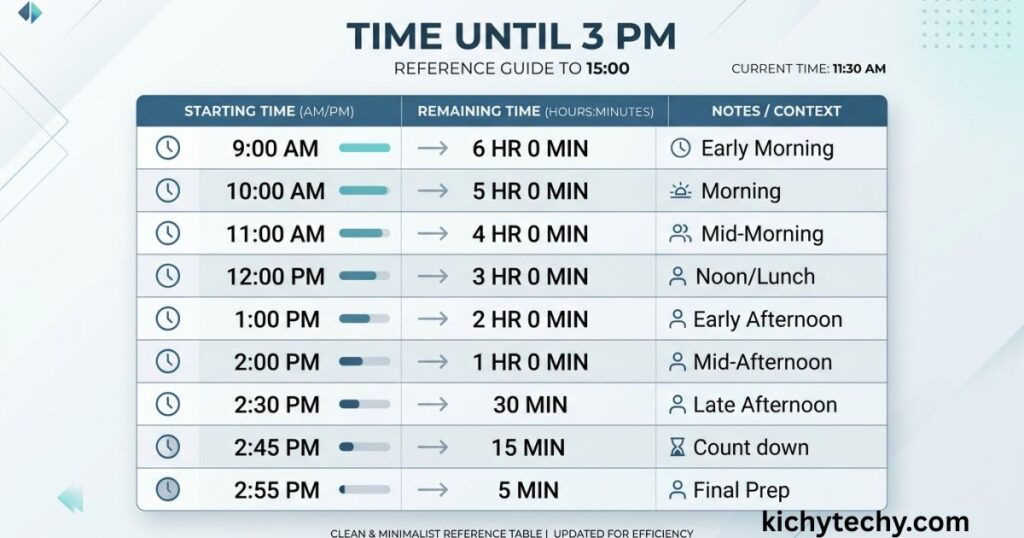
Here’s a table you can scan instead of doing the math yourself. Find your current time on the left, and read off how long you’ve got left.
| Current Time | Time Until 3:00 PM |
| 8:00 AM | 7 hours |
| 9:00 AM | 6 hours |
| 10:00 AM | 5 hours |
| 11:00 AM | 4 hours |
| 12:00 PM (Noon) | 3 hours |
| 1:00 PM | 2 hours |
| 1:30 PM | 1 hour 30 minutes |
| 2:00 PM | 1 hour |
| 2:15 PM | 45 minutes |
| 2:30 PM | 30 minutes |
| 2:45 PM | 15 minutes |
| 2:55 PM | 5 minutes |
| 3:00 PM | You’re there! |
What If It’s Already Past 3 PM?
This happens more than you’d expect — someone searches “how long until 3 PM” after 3 PM has already passed, usually because they’re thinking about 3 PM tomorrow. In that case, the calculation changes slightly: you’re now measuring the time left in today, plus the hours from midnight to 3 PM tomorrow.
| Current Time (Today) | Time Until 3 PM Tomorrow |
| 4:00 PM | 23 hours |
| 6:00 PM | 21 hours |
| 9:00 PM | 18 hours |
| 11:30 PM | 15 hours 30 minutes |
The formula stays the same, you just add 24 hours to your total before subtracting.
Real-World Scenarios Where This Calculation Matters
People don’t search this out of idle curiosity. Usually there’s a real reason behind it. Here are a few common ones:
- Work shifts — Counting down to the end of a shift that wraps up at 3 PM, or a shift that starts at 3 PM.
- School dismissal — Many schools let out around 3 PM, so parents and students track this constantly.
- Flight or train departures — Travelers calculating layover time or how long until boarding.
- Meeting or appointment countdowns — Especially useful when you’re prepping for something and need to know your remaining prep window.
- Fasting or diet schedules — People doing intermittent fasting often set eating windows tied to specific clock times like 3 PM.
- Live events or broadcasts — Sports games, product launches, or webinars scheduled for 3 PM sharp.
Common Mistakes People Make With This Calculation

Forgetting to Convert AM/PM Correctly
The most frequent error is mixing up 12-hour and 24-hour formats. Remember: 12 PM is noon (12:00), not 0:00, and 12 AM is midnight (00:00), not 12:00. Mixing these up throws off the entire calculation.
Not Accounting for Time Zones
If you’re coordinating with someone in another time zone, “3 PM” means something completely different depending on whose clock you’re using. Always clarify whether it’s 3 PM local time, 3 PM their time, or 3 PM in a specific reference zone like UTC.
Ignoring Daylight Saving Time Shifts
Twice a year, the clocks shift by an hour. If you’re calculating time until 3 PM on the exact day of a daylight saving transition, your usual subtraction method might be off by an hour. It’s rare, but worth knowing.
Rounding Too Aggressively
Saying “about 2 hours” when it’s actually 1 hour 40 minutes might not matter for casual plans, but it can throw off anything time-sensitive, like a countdown for a live event or medication schedule.
Doing Mental Math Under Pressure
Honestly, this is the biggest one. When you’re stressed or in a hurry, simple subtraction becomes harder. That’s exactly why quick-reference tables like the ones above exist — they remove the chance of human error.
Why People Search This Topic
Search intent around “how long until X time” queries is almost always immediate and practical. People aren’t researching a concept — they want a fast, accurate number right now. This falls into what’s called a “time-sensitive utility search,” similar to searching “weather today” or “how many days until Christmas.”
A few patterns show up again and again:
- Impatience — Waiting for a specific moment (end of workday, event start) and wanting a concrete number to mentally hold onto.
- Planning — Figuring out how much time is left to finish a task before 3 PM hits.
- Coordination — Making sure everyone in a group call, meeting, or event agrees on the same countdown.
- Curiosity mixed with boredom — Sometimes people just want to know, no real reason attached.
Whatever the reason, the underlying need is the same: a quick, accurate answer without having to think too hard.
Related Calculations You Might Also Need
Since you’re already thinking in terms of clock math, here are a few related calculations that come up just as often:
| Calculation | Formula Logic |
| How long until noon | 12:00 − current time |
| How long until midnight | 24:00 − current time |
| How long until 5 PM | 17:00 − current time |
| How many hours in a workday | End time − start time |
| Time zone conversion | Add/subtract the zone offset |
| Countdown to a specific date | (Target date − today) in days, then hours if same-day |
If you found this guide useful, the same subtraction logic applies to literally any target time — just swap 15:00 for whatever hour you’re counting down to.
Conclusion
Figuring out how long until 3 PM really comes down to one simple subtraction: convert 3 PM to 24-hour time (15:00), convert your current time the same way, then subtract.
The math itself is basic, but small mistakes, mixing up AM and PM, forgetting time zones, or rushing under pressure, are what usually throw people off. Keep the reference table handy, remember the borrowing trick for minutes, and you’ll never second-guess a countdown again.
Frequently Asked Questions
How do I calculate how long until 3 PM from my current time?
Convert 3 PM to 24-hour format (15:00), convert your current time the same way, then subtract your current time from 15:00. The result is your remaining hours and minutes.
How many hours are there between 9 AM and 3 PM?
There are exactly 6 hours between 9 AM and 3 PM. This is a common workday span, roughly matching a standard shift with a lunch break.
What if I need to know how long until 3 PM in a different time zone?
First convert the target 3 PM into your own local time using the time difference between the two zones, then apply the standard subtraction method using your local current time.
Does daylight saving time affect the countdown to 3 PM?
Only on the specific days clocks change. Outside of those two days a year, daylight saving time has no effect on a same-day countdown to 3 PM.
Why do people search “how long until 3 PM” instead of just checking a clock?
Most people already know the current time but want quick, accurate math done for them rather than working it out themselves, especially when they’re busy, distracted, or coordinating with others.