Until 2:30 PM: How to Calculate the Exact Time Left (With Examples & Tables)

You typed “until 2:30 PM” into a search bar because you need one thing: how much time is left before that clock hits 2:30. Maybe it’s a flight boarding time, a deadline, a doctor’s appointment, or the countdown to when your shift finally ends. Whatever it is, you don’t need a lecture — you need the number.
This guide gives you that number, shows you exactly how to work it out yourself in ten seconds, and walks through the scenarios where “until 2:30 PM” trips people up (looking at you, AM/PM mix-ups and 24-hour clock confusion).
Quick Answer
To find the time until 2:30 PM, subtract your current time from 2:30 PM (14:30 in 24-hour format).
- Formula: Time Remaining = 2:30 PM − Current Time
- If the current time is after 2:30 PM, you’re calculating for tomorrow’s 2:30 PM instead.
- If you’re not sure whether “2:30 PM” means today or a specific date you scheduled, always double-check the AM/PM label — this is the single biggest source of error.
Below, we’ll break this down with real examples, a reference table you can scan in five seconds, and the common mistakes that throw people off.
Why People Search “Until 2:30 PM”

This phrase shows up in searches for a handful of very practical reasons:
- Meeting or call prep — “I have a call at 2:30 PM, how long do I have to finish this task?”
- Flight or train boarding — boarding passes often list a specific PM time, and travelers want a countdown.
- Work shifts — checking how much longer until a shift, break, or clock-out time.
- Fasting or medical windows — intermittent fasting apps, medication timing, or “nothing to eat until 2:30 PM” style instructions.
- Deadlines — assignments, bids, or online sales that close at 2:30 PM sharp.
- Countdown curiosity — sometimes it’s just “how much of my day is left.”
Each use case needs the same math, but the stakes are different. Missing a flight boarding time by five minutes matters a lot more than missing a lunch break by five minutes.
How to Calculate Time Until 2:30 PM (Step-by-Step)
Here’s the manual method, no calculator app required.
Step 1: Convert 2:30 PM to 24-hour time
2:30 PM = 14:30. This removes any AM/PM ambiguity right away.
Step 2: Convert your current time to 24-hour format
If your watch says 11:15 AM, that’s just 11:15. If it says 1:45 PM, that becomes 13:45.
Step 3: Subtract current time from 14:30
Subtract hours first, then minutes. If minutes go negative, borrow 60 minutes from the hour column.
Example: Current time is 11:15 AM (11:15)
- 14:30 − 11:15
- Hours: 14 − 11 = 3
- Minutes: 30 − 15 = 15
- Result: 3 hours 15 minutes until 2:30 PM
Step 4: If the result is negative, add 24 hours
This means 2:30 PM already passed today — you’re now counting toward tomorrow’s 2:30 PM.
Example: Current time is 6:00 PM (18:00)
- 14:30 − 18:00 = −3:30
- Add 24:00 → 20:30
- Result: 20 hours 30 minutes until 2:30 PM tomorrow
That’s the whole method. It works for any target time, not just 2:30 PM — swap in whatever hour you need.
Time Remaining Until 2:30 PM: Quick Reference Table
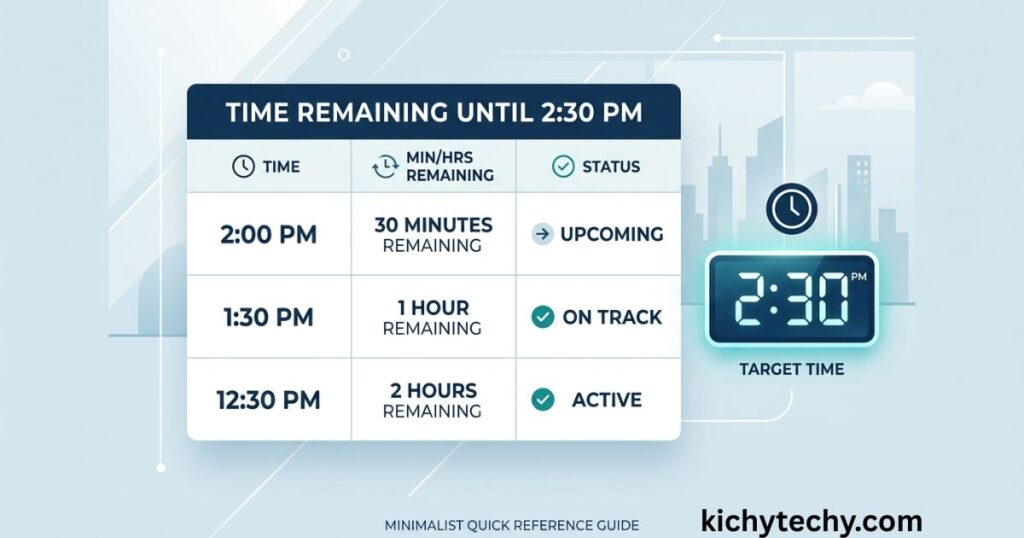
Instead of doing the math each time, use this table to check common starting points.
| Current Time | Time Until 2:30 PM |
| 6:00 AM | 8 hours 30 minutes |
| 7:30 AM | 7 hours 0 minutes |
| 9:00 AM | 5 hours 30 minutes |
| 10:45 AM | 3 hours 45 minutes |
| 12:00 PM (Noon) | 2 hours 30 minutes |
| 1:00 PM | 1 hour 30 minutes |
| 1:45 PM | 45 minutes |
| 2:00 PM | 30 minutes |
| 2:15 PM | 15 minutes |
| 2:30 PM | 0 minutes (it’s now) |
| 3:00 PM | 23 hours 30 minutes (until tomorrow) |
| 6:00 PM | 20 hours 30 minutes (until tomorrow) |
| 11:59 PM | 14 hours 31 minutes (until tomorrow) |
Converting the Countdown Into Other Units
Sometimes “hours and minutes” isn’t the format you actually need. Here’s how the same gap breaks down depending on what you’re working with — using the 3 hours 15 minutes example (11:15 AM to 2:30 PM) as our base.
| Unit | Value |
| Hours (decimal) | 3.25 hours |
| Total minutes | 195 minutes |
| Total seconds | 11,700 seconds |
| Fraction of a workday (8 hrs) | About 40.6% of an 8-hour day |
| Fraction of full day (24 hrs) | About 13.5% of the full day |
Quick tip for decimal hours: To convert minutes into a decimal fraction of an hour, divide by 60. So 15 minutes ÷ 60 = 0.25, which is why 3 hours 15 minutes becomes 3.25 hours. This matters if you’re logging billable hours or filling out a timesheet.
Real-World Scenarios
Scenario 1: Catching a flight
Your boarding pass says boarding closes at 2:30 PM. It’s currently 12:50 PM at the airport.
- 14:30 − 12:50 = 1 hour 40 minutes
- You have 1 hour 40 minutes — plenty of time for security if you’re already past check-in, tight if you’re not.
Scenario 2: Finishing a task before a call
You have a call at 2:30 PM and it’s 1:58 PM.
- 14:30 − 13:58 = 32 minutes
- 32 minutes left. Wrap up what you’re doing and get ready.
Scenario 3: Overnight deadline
A submission portal closes at 2:30 PM the next day, and it’s currently 9:40 PM tonight.
- Treat “tonight” as 21:40. Since this is already past 14:30 today, you’re counting to tomorrow’s 14:30.
- 24:00 − 21:40 = 2 hours 20 minutes (to midnight), then + 14:30 = 16 hours 50 minutes total
Scenario 4: Fasting window
An eating window instruction says “nothing until 2:30 PM,” and you woke up at 7:00 AM.
- 14:30 − 7:00 = 7 hours 30 minutes until you can eat.
Common Mistakes and Misconceptions
Mixing up AM and PM. This is by far the most common error. 2:30 AM and 2:30 PM are twelve hours apart — confusing them can throw off an entire schedule.
Forgetting to roll over into the next day. If the current time is already past 2:30 PM, the countdown isn’t negative — it’s pointing at tomorrow’s 2:30 PM instead. People often stop the calculation too early and end up with a nonsense negative number.
Ignoring time zones. “2:30 PM” only means something specific if you know whose 2:30 PM it is. A flight boarding time is in local airport time; a virtual meeting invite might be in the organizer’s time zone, not yours. Always check.
Mishandling the minutes borrow. When subtracting, if your current minutes are higher than 30 (like 2:45), you can’t just subtract straight across — you need to borrow an hour. Skipping this step is where most manual math errors happen.
Assuming “until” means “starting at.” “Until 2:30 PM” usually means a deadline or endpoint, not a start time. Read the original context carefully — a fasting instruction, a sale, or a shift boundary can use “until” differently depending on phrasing.
Related Calculations You Might Also Need
- Time until midnight — useful for deadline calculations that reset daily.
- Time until 5:00 PM — the classic “how much longer until I’m off work” search.
- Hours between two times — for calculating total elapsed time, not just a countdown.
- Converting 12-hour to 24-hour time — the core skill behind every countdown calculation.
- Business days until a date — different from a same-day countdown, useful for deadlines that span weekends.
- Time zone converters — essential once your countdown involves people in different regions.
Learning the core subtraction method above means you can handle any of these variations without needing a new formula each time — you’re just changing the target time.
Conclusion
Figuring out how much time is left until 2:30 PM comes down to one simple subtraction: convert both times to 24-hour format, subtract, and if you land on a negative number, you’re actually counting toward tomorrow.
Whether you’re catching a flight, prepping for a call, or watching the clock until a shift ends, the reference table above should cover most situations at a glance — and the step-by-step method has you covered for anything it doesn’t.
Frequently Asked Questions
How many hours until 2:30 PM from now?
It depends entirely on your current time. Subtract your current time (in 24-hour format) from 14:30. For example, from 9:00 AM it’s 5 hours 30 minutes; from 12:00 PM it’s 2 hours 30 minutes.
What if it’s already past 2:30 PM today?
Then you’re counting toward 2:30 PM tomorrow. Add 24 hours to your calculation, or simply count the remaining hours until midnight and add another 14 hours 30 minutes.
Is 2:30 PM the same as 14:30?
Yes. In 24-hour (military) time, 2:30 PM converts directly to 14:30, since you add 12 hours to any PM time between 1:00 PM and 11:59 PM.
How do I convert the countdown into decimal hours for a timesheet?
Take the minutes portion and divide by 60. So 3 hours 15 minutes becomes 3.25 hours, because 15 ÷ 60 = 0.25. This is the standard method payroll and billing systems use.
Does “until 2:30 PM” account for time zones automatically?
No — you have to check this yourself. A stated time like 2:30 PM only applies to one specific time zone (often the one set by whoever scheduled the event). If you’re in a different zone, convert first before running the countdown.