How Long Until 3:30 PM? The Simple Way to Calculate Time Remaining
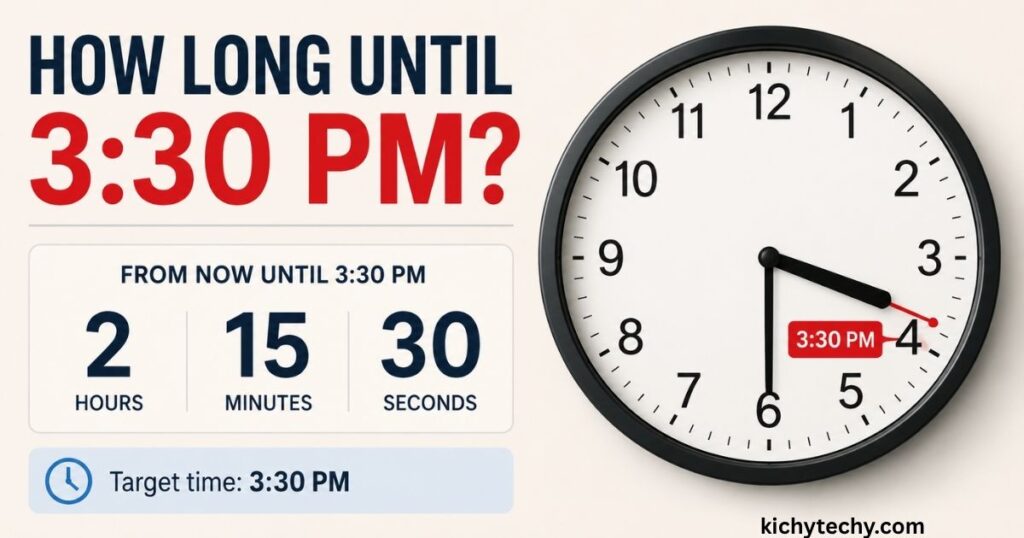
Ever glanced at the clock, seen it’s 11:47 AM, and then just… stared blankly trying to figure out how many hours stand between you and your 3:30 PM meeting? You’re not alone. Time math sounds simple until you’re actually doing it under pressure, and suddenly you’re recounting on your fingers like it’s third grade again.
This guide breaks down exactly how to calculate how long until 3:30 PM from any starting point, with tables, formulas, and real examples so you never have to second-guess your mental math again.
Quick Answer: How Do You Calculate Time Until 3:30 PM?
To find out how long until 3:30 PM, subtract your current time from 3:30 PM (15:30 in 24-hour format). If the current time is earlier in the day, count forward in hours and minutes. If it’s already past 3:30 PM, you’re calculating time until 3:30 PM tomorrow, which means adding the remaining hours of today plus the hours from midnight to 3:30 PM.
Here’s the basic formula:
Time Remaining = 3:30 PM − Current Time
If your current time is in AM, convert everything to a 24-hour clock first (this removes the AM/PM confusion completely). 3:30 PM becomes 15:30, and the subtraction gets much cleaner.
Why This Simple Question Trips People Up
It sounds silly that a subtraction problem causes hesitation, but there’s a real reason for it. Our brains aren’t wired to do base-60 math on the fly — minutes and hours don’t work like normal decimal numbers. You can’t just subtract 47 from 30 without borrowing an hour, and that borrowing step is where most people stumble.
Add in the AM/PM switch, and you’ve got two separate points of confusion stacked on top of each other.
Step-by-Step: How to Calculate Time Until 3:30 PM
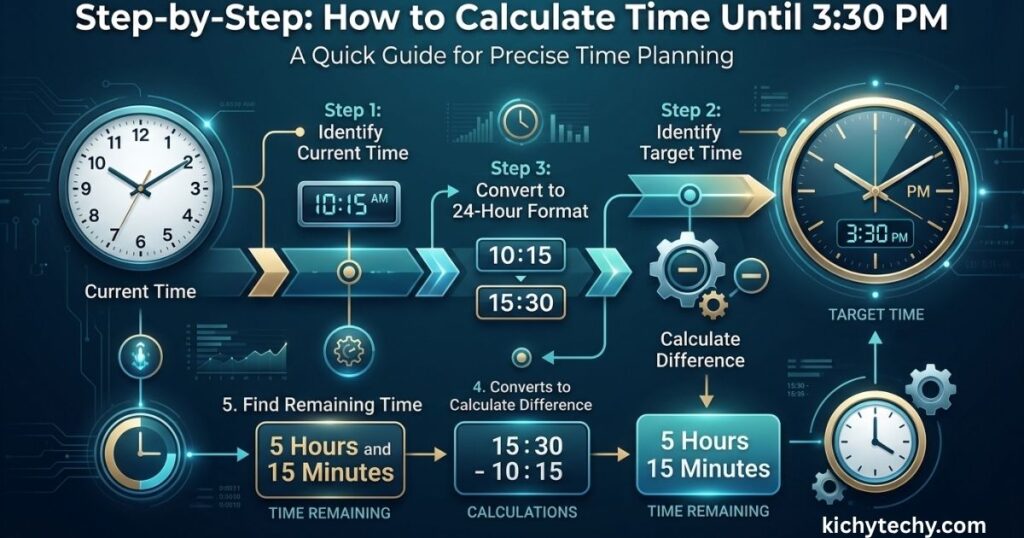
Follow these steps whenever you need to figure out the gap between now and 3:30 PM.
Step 1: Note Your Current Time
Write down the exact time right now, including minutes. Don’t round it — precision matters here.
Step 2: Convert to 24-Hour Format (Optional but Recommended)
If your current time is in the morning (AM), it stays the same in 24-hour format. If it’s in the afternoon or evening, add 12 to the hour. For example, 2:00 PM becomes 14:00.
3:30 PM is always 15:30 in 24-hour time.
Step 3: Subtract the Hours First
Take the hour of your current time and subtract it from 15 (the hour value of 3:30 PM).
Step 4: Subtract the Minutes
Take your current minutes and subtract them from 30 (the minute value of 3:30 PM). If your current minutes are higher than 30, you’ll need to borrow an hour from your Step 3 result and add 60 to your minutes before subtracting.
Step 5: Combine the Results
Put your hour and minute results together, and that’s your answer.
Worked Example
Let’s say it’s currently 10:47 AM.
- Convert to 24-hour time: 10:47 stays 10:47 (AM hours don’t change).
- Subtract hours: 15 − 10 = 5
- Subtract minutes: 30 − 47 doesn’t work directly, so borrow an hour. That makes it 4 hours remaining, and minutes become (60 + 30) − 47 = 43.
- Final answer: 4 hours and 43 minutes until 3:30 PM.
Time Remaining Table: Common Starting Times
Here’s a quick-reference table for some of the most commonly searched starting points.
| Current Time | Time Until 3:30 PM |
| 8:00 AM | 7 hours 30 minutes |
| 9:00 AM | 6 hours 30 minutes |
| 9:30 AM | 6 hours |
| 10:00 AM | 5 hours 30 minutes |
| 10:47 AM | 4 hours 43 minutes |
| 11:15 AM | 4 hours 15 minutes |
| 12:00 PM (Noon) | 3 hours 30 minutes |
| 1:00 PM | 2 hours 30 minutes |
| 1:45 PM | 1 hour 45 minutes |
| 2:00 PM | 1 hour 30 minutes |
| 2:30 PM | 1 hour |
| 3:00 PM | 30 minutes |
| 3:15 PM | 15 minutes |
| 3:29 PM | 1 minute |
Bookmark this table if you find yourself asking this question often — it covers the majority of real-world scenarios people search for.
What If It’s Already Past 3:30 PM?
This is where a lot of people get stuck. If the current time is already past 3:30 PM, you’re not calculating a negative number — you’re calculating time until 3:30 PM the next day.
Here’s how that works:
Time Remaining = (Time until midnight) + (Time from midnight to 3:30 PM, which is 15 hours 30 minutes)
Example: It’s Currently 6:00 PM
- Time from 6:00 PM to midnight: 6 hours
- Time from midnight to 3:30 PM: 15 hours 30 minutes
- Total: 21 hours 30 minutes until 3:30 PM tomorrow
| Current Time (Past 3:30 PM) | Time Until 3:30 PM Tomorrow |
| 4:00 PM | 23 hours 30 minutes |
| 6:00 PM | 21 hours 30 minutes |
| 8:00 PM | 19 hours 30 minutes |
| 10:00 PM | 17 hours 30 minutes |
| 11:59 PM | 15 hours 31 minutes |
| 12:01 AM | 15 hours 29 minutes |
Decimal Conversion: Turning Minutes Into Fractions of an Hour
Sometimes you need the answer in decimal form, especially for scheduling software, payroll calculations, or countdown apps. Here’s how minutes convert to decimal hours:
| Minutes | Decimal of an Hour |
| 15 minutes | 0.25 hours |
| 30 minutes | 0.50 hours |
| 45 minutes | 0.75 hours |
| 10 minutes | 0.17 hours |
| 20 minutes | 0.33 hours |
| 40 minutes | 0.67 hours |
| 50 minutes | 0.83 hours |
So if you calculated “4 hours 43 minutes” earlier, that converts to roughly 4.72 hours in decimal format.
Common Mistakes People Make With Time Calculations
Forgetting to Convert AM/PM Correctly
Mixing up 3:30 AM and 3:30 PM is more common than you’d think, especially when someone’s tired or working across time zones. Always double-check which one you actually mean before you calculate anything.
Not Borrowing an Hour When Subtracting Minutes
If your current minutes are higher than 30, you can’t just subtract straight across. Skipping the “borrow an hour” step is the single most common error in manual time math.
Ignoring Time Zones
If you’re coordinating a meeting or deadline across regions, “3:30 PM” doesn’t mean the same moment for everyone. Always clarify whose time zone you’re working with — Eastern, Pacific, GMT, or otherwise.
Assuming It’s Always Today
If it’s already past 3:30 PM, the calculation shifts to “tomorrow.” Forgetting this leads to confusing negative answers that don’t make sense.
Why People Search “How Long Until 3:30 PM?”
This question pops up more than you’d expect, and it’s rarely just idle curiosity. Common reasons include:
- Countdown to a meeting or appointment scheduled for 3:30 PM
- School dismissal times, since many schools end around this hour
- Work shift endings, especially in retail or healthcare where 3:30 PM is a common shift-change time
- Flight or train departure planning
- Deadline tracking for assignments, submissions, or online orders
- Simple boredom or clock-watching during a slow afternoon
Whatever the reason, the math stays the same — it’s just the context that changes.
Related Time Calculations You Might Also Need
If you found this useful, here are a few related calculations worth bookmarking too:
- How long until noon — useful for lunch planning and half-day scheduling
- How long until 5:00 PM — the classic “end of workday” countdown
- How long until midnight — common for deadline-related searches
- Hours between two custom times — for shift calculations or travel planning
- Military time conversion charts — helpful once you get comfortable with 24-hour format
Once you understand the core subtraction method, all of these follow the exact same logic — you’re just swapping out the target time.
Conclusion
Figuring out how long until 3:30 PM really comes down to one thing: subtracting your current time from 15:30 in 24-hour format, and borrowing an hour when your minutes don’t line up cleanly.
Once you get comfortable with that borrowing step, the whole process takes seconds, whether you’re doing it in your head, on paper, or double-checking with the tables above. And if 3:30 PM has already come and gone for the day, just remember you’re counting toward tomorrow instead.
Frequently Asked Questions
How many hours are there between 9 AM and 3:30 PM?
There are exactly 6 hours and 30 minutes between 9:00 AM and 3:30 PM.
Is 3:30 PM the same as 15:30 in military time?
Yes. In 24-hour (military) time format, 3:30 PM is written as 15:30.
How do I calculate time until 3:30 PM if it’s already past that time today?
Add the remaining hours until midnight to 15 hours and 30 minutes (the time from midnight to 3:30 PM the next day).
What’s a quick trick for calculating time without a calculator?
Convert to 24-hour time first, subtract the hours, then subtract the minutes — borrowing an hour if your current minutes are greater than 30. This removes AM/PM confusion entirely.
Does the time until 3:30 PM change based on time zones?
Yes. “3:30 PM” refers to local time unless a specific time zone is stated, so the countdown will differ depending on where you and the other party are located.


