How Much Does a Gallon of Water Weigh? US vs Imperial Gallon
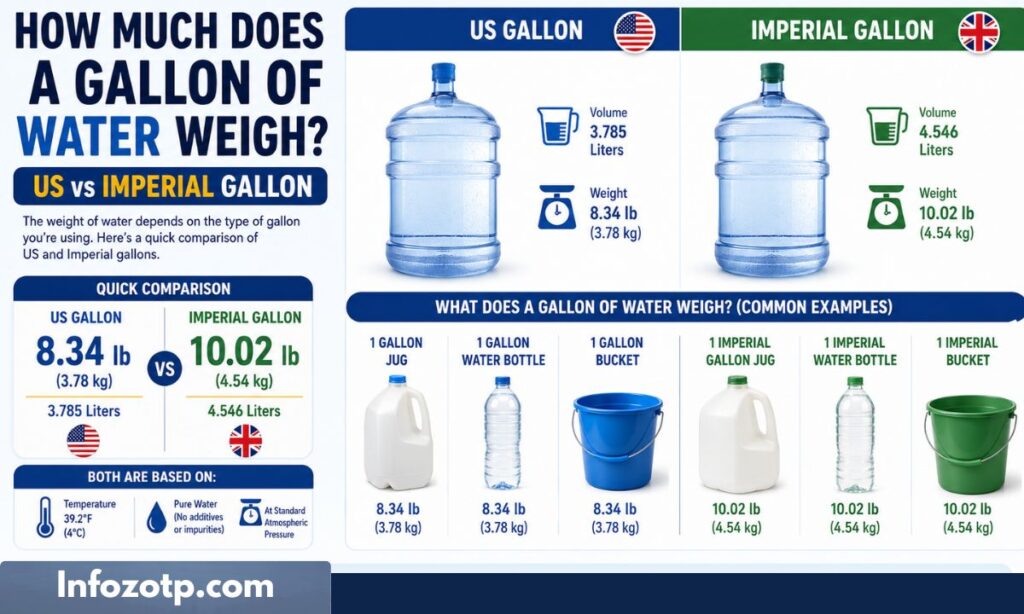
A US gallon of water weighs about 8.34 pounds at room temperature (around 70°F).That’s the short answer. But if you’re filling a fish tank, loading an RV, or just settling an argument with your buddy, you need more than one number. Water weight changes a little depending on temperature, what’s mixed into it, and even which country’s gallon you’re using.Stick around. We’re breaking this down in plain English, no science degree needed.
Why Water Weight Fluctuates: The Density Factors
Water isn’t a fixed brick of weight. It moves, expands, and shrinks depending on its surroundings.The basic math is simple: weight equals volume times density. Since volume (the gallon) stays the same, any change in water weight comes down to density shifting.Think of it like a crowded room. When people spread out, the room feels less packed. Water molecules do the same thing when they heat up.
Why Temperature Creates Small Variations in Water Weight
Cold water is heavier than hot water. Sounds backward, but it’s true.
Water hits its peak density at 39.2°F, just above freezing. At this point, molecules pack in tighter than at any other temperature.
Here’s a quick look at how it shifts:
- Near freezing (39.2°F): about 8.345 lbs per gallon
- Room temperature (70°F): about 8.33 lbs per gallon
- Boiling (212°F): about 8.0 lbs per gallon
The difference is small. For everyday stuff like filling a cooler or a tank, you don’t need to stress over a few tenths of a pound.
How Gravity, Air Pressure, and Elevation Influence Water Weight
Here’s something most articles skip. Weight isn’t just about the water itself, it’s about gravity pulling on it.On Earth, gravity is pretty steady everywhere you go, so this rarely matters for daily life. But technically, water weighs a hair less on a mountain than at sea level because gravity’s pull is slightly weaker up there.
Air pressure plays a tiny role too. Less atmosphere pressing down at higher elevation means a tiny drop in measured weight.Bottom line? Unless you’re a scientist in a lab, ignore this one. Your bathroom scale won’t notice the difference between your kitchen and a mountain cabin.
Freshwater vs Salt Water
Salt changes the game. Adding salt to water increases the mass without adding much volume, so saltwater weighs more than fresh water.Picture two identical buckets, one filled with tap water, one with ocean water. The saltwater bucket will always tip the scale heavier.This matters most to reef tank owners, boaters, and anyone dealing with marine setups.
How Much Does a Gallon of Saltwater Weigh?
A gallon of saltwater weighs approximately 8.55 pounds, compared to 8.34 pounds for fresh water.That extra 0.21 pounds might not sound like much. But scale it up to a 50 gallon saltwater aquarium, and you’re carrying over 10 extra pounds compared to a freshwater tank the same size.If you’re building a stand for a reef tank, don’t just Google “water weight.” Search specifically for saltwater numbers, or your stand might be underbuilt.
How Much Does 1 Liter of Water Weigh?
One liter of water weighs almost exactly 1 kilogram, or about 2.2 pounds, at room temperature.This is one of the easiest conversions in the metric system. Grams and milliliters basically line up one to one for water, which is why chefs and scientists both love using liters.Cold tap water at 39°F weighs marginally more, right around 1.0 kg. The difference is too small to matter unless you’re doing lab work.
How Much Does 500ml of Water Weigh?
A 500ml bottle of water weighs close to 1.1 pounds, or roughly 500 grams.That’s half a liter, so naturally it’s half the weight. This handy 1 to 1 ratio between milliliters and grams makes it easy to eyeball weight without a scale, especially useful for cooking and baking.Next time a recipe calls for 500ml of water, you can trust it weighs almost exactly half a kilo.
How Much Does a 16.9 oz Bottle of Water Weigh?
Your average water bottle from the store, the 16.9 oz size, weighs about 1.12 pounds total.Break it down and the liquid alone is about 1.1 pounds. The plastic bottle itself adds roughly a third of an ounce on top of that.Small detail, but if you’re shipping cases of water or packing a cooler for a road trip, those extra ounces per bottle add up fast across a full case.
US Gallon vs Imperial Gallon
Here’s where a lot of people get tripped up, especially when reading guides from the UK, Canada, or Australia.
A US gallon and an imperial gallon are not the same size. The imperial gallon is bigger, which means it holds more water and weighs more too.
- US gallon: 8.34 lbs (3.78 liters)
- Imperial gallon: 10.02 lbs (4.54 liters)
If you’re following a British DIY guide for a 10 gallon project using US math, you could be off by nearly 17 pounds. Always check which gallon your source is using before you calculate anything important.
Also Read This:How Heavy is 50 Pounds? 12 Common Things That Weigh 50 Pounds
How Much Does an Imperial Gallon of Water Weigh?
An imperial gallon of water weighs about 10.02 pounds, roughly 20 percent heavier than a US gallon.
The reason comes down to pure volume. An imperial gallon holds 4.54 liters compared to the US gallon’s 3.78 liters, and since a liter of water is almost exactly one kilogram, more liters means more pounds.
This gap matters most in shipping and fuel calculations. Fifty imperial gallons adds around 501 pounds, while fifty US gallons only adds about 417 pounds, an 84 pound swing that can push a small trailer past its safe limit.
How Much Does 5 Gallons of Water Weigh?
Five gallons of water weighs about 41.7 pounds.That’s the weight of your standard office water cooler jug when it’s full. If you’ve ever wrestled one of those onto a dispenser, you already know 40 plus pounds is no joke on your back.Lift with your knees, not your spine. Seriously.
How Heavy Is 10 Gallons of Water?
Ten gallons weighs around 83.4 pounds, basically two full 5 gallon jugs stacked together.This is a common size for camping containers and small RV tanks. It’s manageable to move on a hand truck but rough to carry solo for any real distance.
How Heavy Is 30 Gallons of Water?
Thirty gallons comes in at about 250.2 pounds.Picture a backyard rain barrel filled to the brim. That’s roughly the weight of three grown adults sitting on top of your deck, minus the deck chairs.This is exactly why rain barrels need solid, level ground underneath them. A tilted or weak base can crack under that kind of load.
How Much Does 50 Gallons of Water Weigh?
Fifty gallons weighs approximately 417 pounds.This is the ballpark for a standard home water heater tank. Add the weight of the tank itself, and you’re often looking at 500 plus pounds sitting in your utility closet.Homeowners doing plumbing work should always double check floor support before installing anything this heavy, especially on upper floors.
How Much Does 100 Gallons of Water Weigh?
One hundred gallons weighs about 834 pounds.A 100 gallon aquarium holds this much water alone, not counting the glass, gravel, and decorations on top. Fish tank stands need serious weight ratings for setups this size, and skipping that check is a common rookie mistake.
How Much Does 250 Gallons of Water Weigh?
Two hundred fifty gallons weighs roughly 2,085 pounds, just over one ton.Farmers and gardeners using irrigation tanks this size need to think about ground support carefully. A ton of shifting weight on soft or uneven ground is a recipe for a tipped tank.
How Much Does 500 Gallons of Water Weigh?
Five hundred gallons tips the scale at about 4,170 pounds, over two tons.This size shows up in bigger storage tanks and small pool fills. At this weight, even a small math error in your planning could mean exceeding a trailer’s axle rating or a foundation’s load limit.
Real World Applications: Why This Number Matters
Knowing water weight isn’t just trivia, it actually saves money and prevents accidents.
Aquariums and fish tanks: A “10 gallon” tank doesn’t weigh 83 pounds alone. Add glass, gravel, and equipment, and you’re often closer to 110 or 120 pounds total.
RVs and boats: Water management is weight management on the road. Filling a 40 gallon freshwater tank adds over 330 pounds, which directly affects your fuel mileage and braking distance.
Backpacking and emergency prep: Two gallons of emergency water adds over 16 pounds to your pack. That can be 30 to 40 percent of a hiker’s total load, so plan your water stops wisely.
How Other Liquids Compare
Water isn’t always the heaviest liquid on the shelf.
- Milk: about 8.6 lbs per gallon, heavier thanks to fat and protein content
- Gasoline: about 6.3 lbs per gallon, which is why it floats on top of water during a spill
- Honey: a hefty 12 lbs per gallon, one of the densest kitchen liquids around
- Propane: roughly 4.24 lbs per gallon, about half the weight of water
Next time you’re comparing shipping weights or fuel loads, remember that “a gallon” means very different things depending on what’s inside it.
Common Mistakes People Make With Water Weight Calculations
Even smart people mess this up sometimes.The biggest mistake is mixing up US and imperial gallons, especially when following online guides or recipes from other countries. Always check the source’s location first.
Another common slip is forgetting container weight. A “50 gallon tank” usually means 50 gallons of water plus the tank itself, and that difference can be 20 pounds or more depending on the material.Finally, people forget saltwater and freshwater aren’t interchangeable in calculations. If you’re stocking a reef tank, use saltwater numbers, not freshwater ones, or your stand and floor could be underrated for the actual load.
Quick Reference Chart
| Volume | Weight (lbs) | Weight (kg) |
| 1 Gallon | 8.34 lbs | 3.78 kg |
| 5 Gallons | 41.7 lbs | 18.9 kg |
| 10 Gallons | 83.4 lbs | 37.8 kg |
| 30 Gallons | 250.2 lbs | 113.5 kg |
| 50 Gallons | 417 lbs | 189 kg |
| 100 Gallons | 834 lbs | 378 kg |
| 250 Gallons | 2,085 lbs | 946 kg |
| 500 Gallons | 4,170 lbs | 1,890 kg |
Conclusion
A gallon of water weighs about 8.34 pounds in the US, and closer to 10.02 pounds if you’re using the imperial system. Temperature, salt content, and which country’s gallon you’re using all nudge that number up or down.For daily life, from filling a cooler to loading an RV, the standard numbers in this guide are all you need. Save this page, bookmark the chart, and you’ll never have to Google “how much does water weigh” again.Got a project where water weight actually matters? Drop a comment and let us know what you’re building. We read every one.