How Big Is 6mm? 12 Everyday Objects That Show You Instantly
You ordered a bolt online and had zero clue how small 6mm really is. Or a doctor said “6mm spot” and you just nodded along, totally lost.Quick answer. 6mm equals 0.6cm and about 0.236 inches. That is just a touch under a quarter inch.
This guide gives you 12 real objects sitting at that exact 6mm size so you never have to guess again. Grab your keys, your pencil, or your spare change. You probably already own three of these.
How Big Is 6mm, Really?
Numbers on a screen do not mean much until you hold something in your hand. So here are three fast body based anchors before the full list.
Your pinky fingernail runs 8 to 12mm wide, so 6mm is noticeably thinner than that. Six ballpoint pen tips lined up side by side also land you at 6mm, since each tip is about 1mm.
On any tape measure, just count six tiny tick marks past a centimeter line. That tiny gap is your 6mm reference for life.
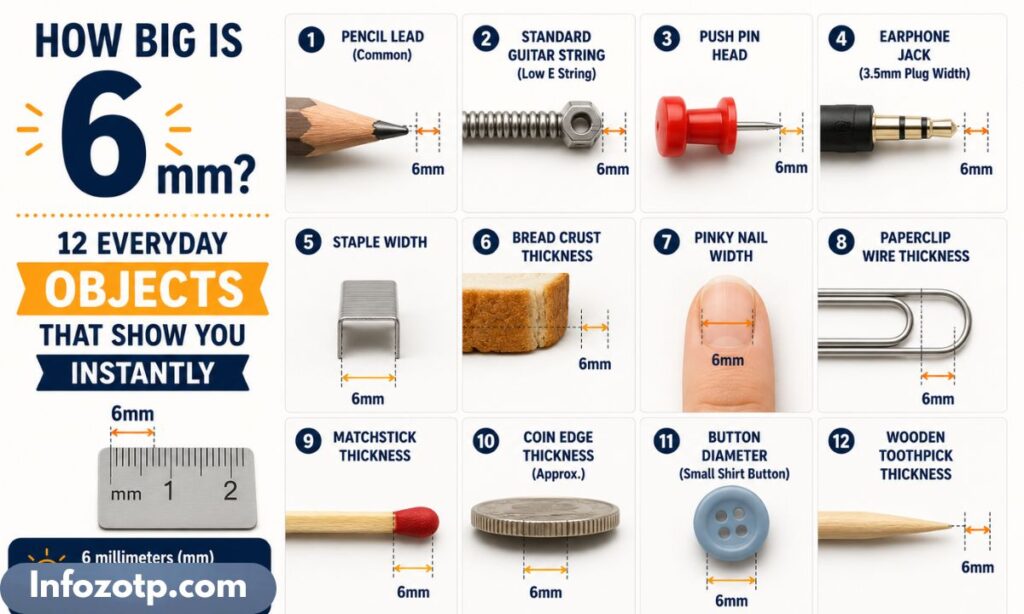
12 Real Things That Measure Approximately 6mm
| Object | Size | Category |
| M6 Bolt Shank | 6.0mm exact | Hardware |
| Tactile Push Button | 6.0mm x 6.0mm | Electronics |
| Pencil Eraser Diameter | 5 to 7mm avg | Stationery |
| Pencil Hex Width | about 6mm | Stationery |
| Four Stacked Dimes | 5.4mm, close | Coins |
| Three Stacked Nickels | 5.85mm, closer | Coins |
| Small Green Pea | 6 to 8mm | Food / Medical |
| Standard Straw (outer width) | about 6mm | Kitchen |
| Butterfly Earring Back | about 6mm | Jewelry |
| Drawstring Cord | 6mm standard | Apparel / Crafts |
| Small Shirt Button | about 6mm | Sewing |
| Size J/10 Crochet Hook | 6.0mm exact | Crafts |
1. M6 Bolt (Shank Diameter)
The M6 bolt wears its size right in the name. The 6 means the shank is 6mm across, no guessing needed.
You have handled one already if you ever built flat pack furniture or fixed a bike stem. Next time you shop for bolts online, hold an M6 in your hand first. It saves you a return trip.
This is one of the most common hardware sizes in the world for a reason. It fits nearly every basic build job.
2. 6x6mm Tactile Push Button Switch
This tiny square switch measures exactly 6mm by 6mm on every side. It shows up in remotes, Arduino kits, and basically every beginner electronics box out there.
It clicks satisfyingly and costs pennies in bulk. If you have ever opened a broken remote, you have seen this exact small electronic part staring back at you.
3. Pencil Top Eraser Diameter
Flip your pencil over. That pink eraser cap measures roughly 6mm across. Brands wobble a little between 5 and 7mm, but 6mm is the average you will hit most often.
You have touched this thing a thousand times without ever clocking its size. Now it lives rent free in your head as a millimeter size reference forever.
4. Pencil Hexagon Face to Face Width
Look at the flat sides of a normal hexagon pencil, not the pointy corners. Flat side to flat side, you are looking at about 6mm.
Crafters quietly use pencils as backup gap gauges all the time. Press the flat edge into a slot or channel and you get a rough but honest size comparison with zero tools.
5. Four Stacked US Dimes
A single US dime is 1.35mm thick. Stack four of them and you land at 5.4mm. That is close to 6mm, just a hair under it, so treat this as a fast estimate, not a lab measurement.
Coin stacks are old school tricks that machinists still use today. Keep a few dimes in your desk drawer for a quick coin thickness check anytime.
6. Three Stacked US Nickels
Nickels run thicker per coin at 1.95mm each. Stack three and you hit 5.85mm, which lands closer to true 6mm than the dime stack does.
Nickels also sit flatter and steadier on a table, so the stack barely wobbles. Use this method when you want the tightest coin based estimate you can get without a ruler.
7. Small Green Pea
Doctors love using a pea to explain scan results because numbers alone feel cold and scary. A small pea sits right around 6 to 8mm, which lines up with common lung or thyroid nodule sizing talk.
If a doctor ever says smaller than a pea, that usually means under 6mm. It turns a scary chart number into something you can actually picture, which matters more than people admit.
Also Read This:15 Common Things That Are 5 Inches Long
8. Standard Drinking Straw
Most plastic and paper straws measure about 6mm on the outside width. The inside opening runs a touch smaller, but the outer wall lands close to that mark across most brands.
Slice a short ring off any straw and you get an instant 6mm circle template. Crafters use this trick for punching clean holes in leather, foam, or thick paper.
9. Butterfly Earring Back Width
That little metal wing behind your earring post measures about 6mm at its widest point. That size is not random. It is wide enough to stay put, small enough to hide behind your ear.
If you are replacing lost earring backs online, confirm this width before you buy. Guess wrong and you end up with backs that either slide right off or refuse to push on at all.
10. Drawstring or Braided Cord Diameter
The cord threading through your hoodie or sweatpants waistband almost always measures 6mm across. It is also the go to starter size for beginner macrame projects at craft stores everywhere.
This width glides through fabric channels smoothly and still grips a knot without slipping loose. Grab the wrong size cord and you either get a floppy mess or a cord that will not thread at all.
11. Small Shirt or Craft Button
True 6mm buttons go by the name 10L in the button trade, and they show up on blouses, baby clothes, and doll outfits. They blend into a mixed button jar easily, which is exactly why measuring first actually matters here.
Before sewing a replacement onto a nice shirt, measure one of the buttons still attached. Even a 1mm mismatch looks fine in the jar but stands out the second it hits the fabric.
12. Size J or 10 Crochet Hook
Crochet hooks are labeled by their actual width in millimeters, and the J or size 10 hook measures exactly 6mm. It is one of the most popular hook sizes for scarves, blankets, and beginner projects.
If you crochet even occasionally, you already own a perfect 6mm size tool sitting in your craft bin. No measuring needed. The number is printed right on the hook.
Why Getting 6mm Right Actually Matters
A millimeter feels tiny until it ruins your order. Buy the wrong drill bit, cord, or earring back and suddenly nothing fits the way it should.
This is the real headache behind most online return requests for small hardware and craft supplies. People eyeball a size, guess wrong, and pay shipping twice.
Knowing a handful of solid size reference objects fixes this problem for good. You check against something in your pocket instead of hoping the listing photo is accurate.
6mm Compared To Nearby Sizes
Size confusion usually happens between neighbors, not between numbers far apart. So here is how 6mm stacks up against the sizes people mix it up with most.
5mm sits noticeably thinner and often gets confused with 6mm cord or earring backs. 8mm runs about a third larger, roughly the jump from a standard straw to a thicker boba straw.
Side by side, the gap is obvious every single time. Alone, without a reference, most people cannot tell 5mm from 6mm from 8mm at a glance.
Measuring 6mm Without a Ruler
No ruler in sight. No problem at all.
Stack four dimes for a fast estimate at 5.4mm. Stack three nickels instead if you want the closer read at 5.85mm.
Press a pencil’s flat hex edge into a gap for a rough physical check. Or open your phone’s measuring app for anything that does not need lab level precision.
Conclusion
Six millimeters shows up more often than most people realize, from bolts and buttons to cords and craft hooks. The fastest trick to remember it forever is three stacked nickels landing at 5.85mm, about as close to true 6mm as pocket change gets.
Next time this number pops up on a listing, in a craft store, or in a doctor’s note, you now have a real object to picture instead of a blank stare. That is the whole point of a good size reference. It turns a random number into something you already understand.